


In this issue, I’m reading the curve to examine:
Where physical AI is poised to take hold
Why data will shape how quickly physical AI advances
What the next phase of human-machine collaboration looks like
Reading the Curve
I’ve always enjoyed finding ways to get a glimpse of the future. A few years ago while visiting Los Angeles, I felt the future when getting my first ride from an autonomous ride hailing service and seeing an expanding fleet of self driving food delivery vehicles. At first, these experiences were novel enough that I made a point of seeking them out.
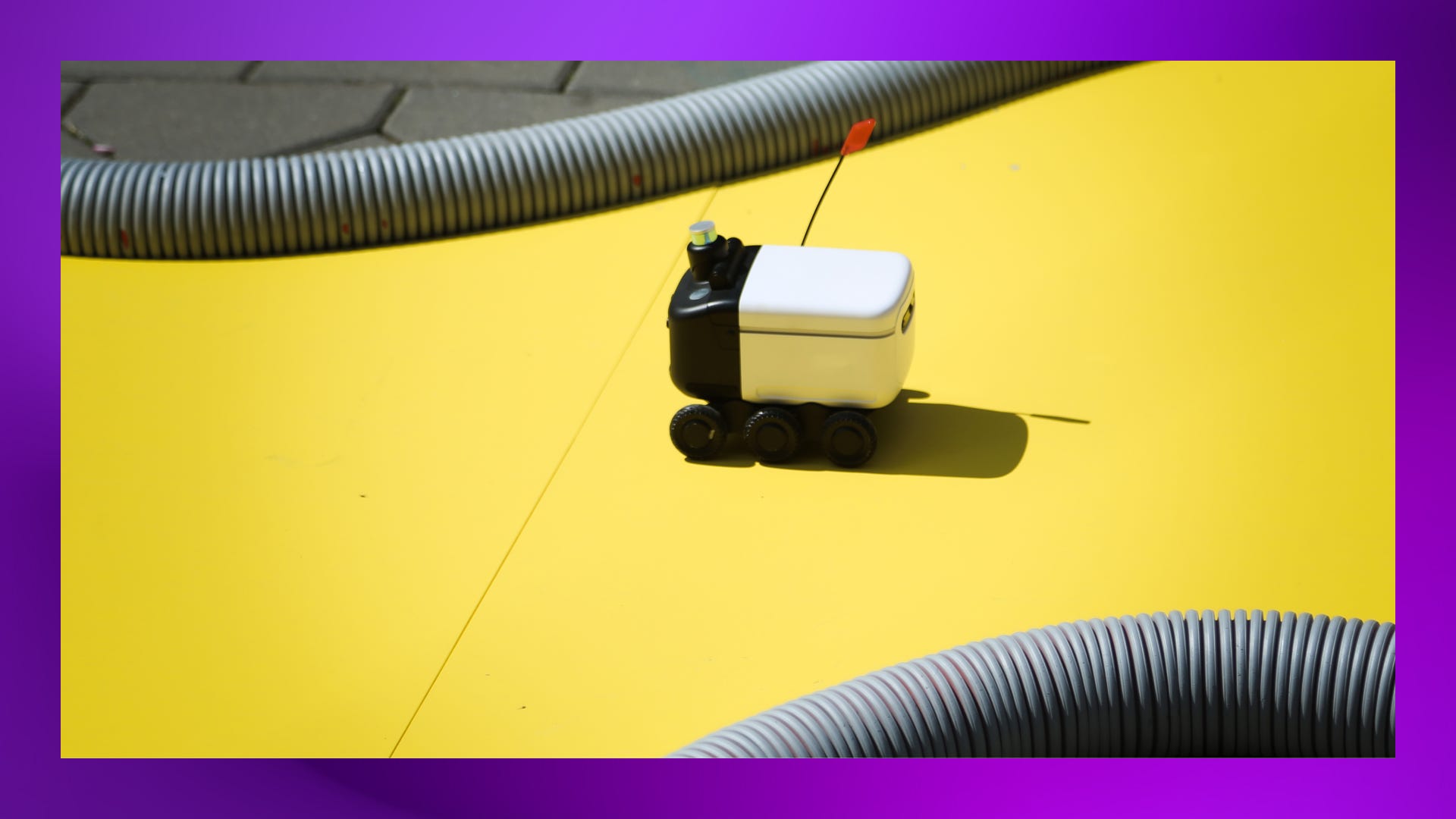
Today, however, these once-futuristic experiences are easier to find. Autonomous vehicles and delivery robots are moving into more cities and everyday settings, bringing physical AI out of controlled environments and into the world around us.
In fact, Morgan Stanley Research forecasts that the market for robotaxis could reach $1 trillion by 2040. That’s just one application. Robots are working alongside people on factory floors, moving through hospital hallways and warehouses, and increasingly venturing into less predictable environments like our sidewalks.
As their capabilities and applications have expanded, so has our idea of what constitutes a robot. My colleague Jim Wilson, Accenture’s global managing director of IT research, has been following this evolution for years. In a 2015 Harvard Business Review article, he noted that robots could already take radically different forms, from industrial arms to autonomous vacuums to humanoids. Rather than defining them by how they look, Jim offered a broader definition based on their relationship with us: “an artificially created system designed, built and implemented to perform tasks or services for people.”
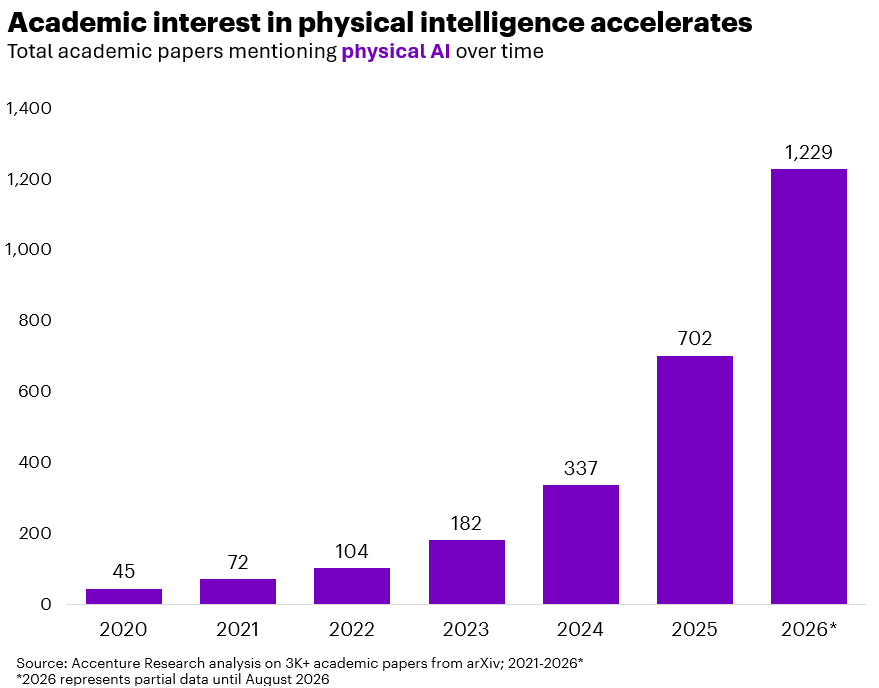
AI is accelerating this evolution. Our research shows that interest in physical AI is rising, as measured by activity in academic papers. This trend suggests a coming wave of AI that moves intelligence beyond screens and into the physical world around us.
In fact, companies are already changing how they plan for the future. My colleague Max Blanchet, who leads Accenture’s global supply chain and operations strategy practice, wrote in December that nearly all operational activities for manufacturers will be either AI-augmented with human oversight or fully autonomous by 2030. Today, 63% of these companies have integrated autonomy into their strategic plans and 25% are actively implementing it.
Investors appear to be betting on this future, too. Benjamin Lawrence, who leads CB Insights’ emerging tech and industrial research teams, said their research shows that physical AI has become the most active area of the AI market, by deal volume.
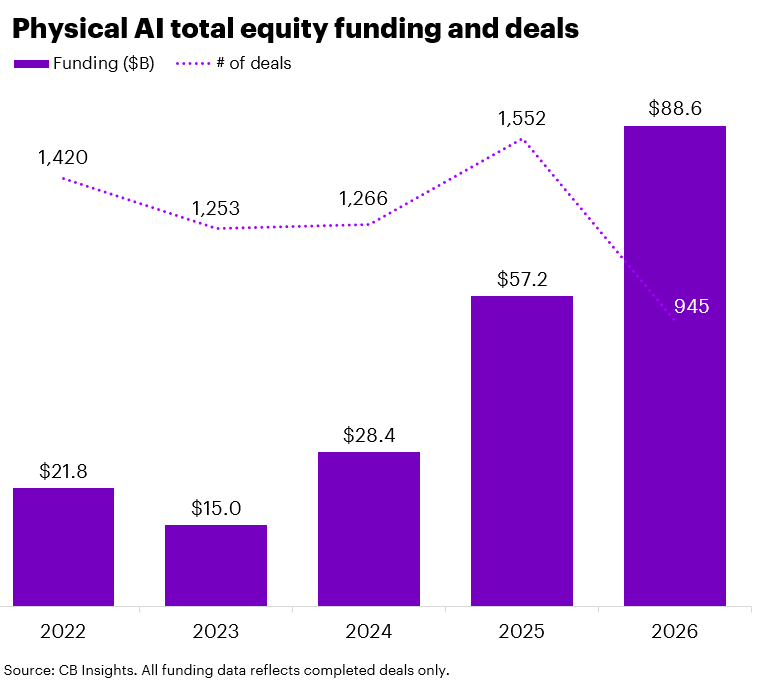
“Essentially we have a massive amount of funding from investors going to physical technologies because the application layer, the software layer, got a lot of funding in the last few years and you don’t have as much first mover advantage,” Benjamin said. This includes investments in companies that make AI-powered robotics, drones and autonomous vehicles, as well as the software systems that control them, the model layer and the adjacent supporting hardware.
The value proposition of physical AI solutions is anchored in a combination of multiple factors including productivity enhancement, operational efficiency and/or increased safety.
To help me understand what comes next and what it will take to get us there, I spoke with Benjamin and my colleagues at Accenture Research, including Jim, and emerging tech researchers Prashant Shukla and Shruti Shalini.
They told me how technology is getting smarter, but also that making tech useful in the physical world means solving for everything from data scarcity and safety to how people and machines work together.

Intelligence takes on a physical form
Up until this latest issue of my newsletter, we’ve mostly addressed how intelligence helps us think, decide and act in the digital universe. Physical AI takes that intelligence out into the world around us.
“We have all the intelligence in the world now. We have AI systems that can improvise and learn,” said Prashant, referring to the most advanced LLMs that can perform intelligent feats in seconds that no human could match. “What if we put this level of intelligence in things? All of a sudden you’ve got an embodiment of a very intelligent being.”
But putting intelligence into things introduces a new challenge, because those things have to work in the environments we’ve built for people. Intelligence alone isn’t enough.
The physical shape and fit of a technology must match the environment it’s meant to serve. The robots that fold laundry or vacuum our floors need to look different from the bots making cars and assembling equipment on the factory floor.
The environment itself matters, too. Robots have worked in factories for decades, where tasks and surroundings can be tightly controlled. What’s changing now is their ability to move beyond those settings into places like roads and sidewalks, where the world is far less predictable.
Autonomous vehicles navigating around San Francisco, Los Angeles and various other cities in the south of the US may be the strongest proof of concept for physical AI systems leaving the factory floor for the mean streets.
Operating in the physical world raises the stakes considerably. A mistake made by digital AI can often be corrected, but a machine acting in the physical world can cause physical harm. As Prashant put it, “the calculus of risk is much higher.” In order to safely operate, these systems must learn how the physical world behaves.
That brings us to one of the biggest constraints on physical AI today: the data to teach them.
Data data everywhere, but not the kind we need
Our digital lives generate an enormous amount of information about what we search, watch, buy, say and do online. That abundance helped fuel the rise of large language models. But physical AI needs a different kind of data.
“The difference is you need to train these systems on atoms and objects,” said Jim.
And unlike the text, images and video already available online, much of that data still has to be created or captured.
Benjamin of CB Insights described three ways that companies are going about it. One is synthetic data, which can be generated through simulation, generative models or other methods to generate experiences a physical system can learn from. “But it’s not a replacement. It’s a complement. You can use that to help fill gaps, but you can’t rely on it.”
Another is human demonstration data. Workers can wear sensor-equipped gloves or other devices while performing physical tasks over and over, capturing the movements a robot eventually needs to learn. This is labor-intensive, making it difficult to generate the sheer volume of real-world data that these systems require.
Then there’s the data the physical world is already producing. Cameras in warehouses can capture how people and goods move through a facility, while sensors can record existing machines and systems as they operate. Benjamin pointed to autonomous driving as perhaps the clearest example, relying on human drivers navigating real roads, including the hiccups every driver has experienced: “The squirrel running in the road, the human walking across the street or the car that turned when it shouldn’t,” Benjamin said. “And you do that over millions and millions of miles and eventually you get a system that is actually capable. That’s where the training data comes into play.”
That last example gets at the scale of the challenge. Physical AI doesn’t just need to learn how to perform a task. It needs enough experience of the physical world to know what to do when reality doesn’t go according to plan. Which helps explain why some environments are much closer to physical AI readiness than others.
A question of readiness
So where is physical AI showing up first? The answer has a lot to do with how predictable the environment is. A factory floor or warehouse, where movements and processes can be controlled, presents a very different challenge from a construction site or city sidewalk.
“Most of the early stage robot systems were in controlled environments like factories: single task robots, flexible robots, collaborative robots,” said Jim. “Where the robotic systems leave the factory and go into less controlled environments—like sidewalks or drone deliveries—they’re doing things that are industrial or consumer applications.”
Collaborative robots have been working alongside people for years and can often be reprogrammed by the people working with them. Jim points to auto manufacturers as examples of companies that have used collaborative robots for at least a decade.
But as physical AI moves into more complex environments, working alongside people becomes a bigger part of the equation. Opportunities range from retail and e-commerce fulfillment to hospitals, where robots can take on routine activities such as retrieving medical supplies, freeing nurses to spend more time with patients.
The closer these systems get to people, the more trust matters. In a hospital or home, for example, physical AI may encounter sensitive information while collecting the real-world data it needs to operate. And, as noted, unlike with digital AI, mistakes can have physical consequences.
Still, there’s a longer view worth keeping in mind. People have been adapting how they work alongside machines for generations. Physical AI is another step in that progression, but one with an important new capability: “A robot in a factory might learn a new way to grasp something in a way that is transferable to other contexts like delivery or even surgical robotics,” Jim said. “You can actually have robotic systems learning from each other.” (Jim and his Human + Machine co-author Paul Daugherty wrote about this recently for Harvard Business Review, detailing how machines learn through trial and error and human feedback.)
Our own ability to learn alongside machines is changing, too. Simulations now allow managers to test many different approaches before putting a physical system into production.
“Now management can see what works best and maximize and innovate in ways they haven’t before. Because you can run simulations or 50 different simulations and choose the ones that you like the most,” Jim said. “Before, when you were putting in a new assembly line in your new plant, you had to get it right at the start.”
In that context, my colleagues Tracey Countryman, Inge Oosterhuis, Jeff Wheless and Rushda Afzal recently published an article (referenced below) in which they explain how “the best manufacturers build AI with workers, not for them”. Leaders who include people in redesigning roles, train them in the flow of work and make it clear who is accountable for outcomes when work includes AI will not merely help their workforces keep pace with the learning curve. They will help them to define it.

Worth Your Attention
From MIT Technology Review, Prashant offered this piece: Why humanoid robots need their own safety rules. It’s a look at the unique risks these robots introduce and the standards needed before they can work closely alongside people.
For Harvard Business Review, my colleagues Tracey Countryman, Inge Oosterhuis, Jeff Wheless and Rushda Afzal wrote this guide to building trust as AI changes the factory floor: The best manufacturers build AI with workers, not for them.
Also from HBR, colleagues Adam Burden, Christian Souche, Shruti Shalini and Alpana Dubey wrote: 5 questions to ask before investing in humanoid robots.
Read more about the shift toward autonomous operations and how manufacturers can prepare for it in Max Blanchet’s article for Ivey Business Journal.
For a deeper look into emerging technologies, explore the Accenture Research Journal, where you can access our full reports on everything from physical AI to cyber resilience.
Overheard
“Can words put down fires? Can words cook an omelet?”
— Dr. Fei-Fei Li, AI pioneer and developer of ImageNet, on what world models can learn that language models cannot
The insights above are made possible by 350 researchers, editors and AI agents across Accenture Research, as well as by the Accenture business leaders who sponsor and shape our agenda and by my colleagues in marketing and communications who help bring these insights to life.