

The AI skills reset
By breaking work into its core components, leaders can develop a clearer, more precise view of where AI creates value and how to capture it.


In this issue, we examine:
Why we need to look beyond just jobs to the core components of work
How to identify the skills that drive disproportionate value
How the value of skills is shifting based on scarcity and impact
Reading the Curve
There’s a lot of discussion about how AI will change work, often focused at the level of jobs: What will be lost? What will be created? And while that conversation is important, it only captures part of what’s happening. What we’re seeing in the data is something more fundamental: The composition of work is changing.
I see this in the students I teach. They are quick to adopt AI and use it to expand what’s possible. At the same time, what matters most isn’t new. The ability to lead, exercise judgment and use creativity to solve problems remains central. If anything, these skills are becoming more important as AI becomes embedded in how work gets done.
The professional world they will enter looks different from the one that I, or my colleagues, experienced as young strategists. These students can already sense that the work ahead will be less about executing tasks and more about applying judgment, creativity and collaboration in new ways.
In fact, recent analysis conducted by my colleagues across 18 industries shows that more than 50% of working hours could be impacted by AI agents. This new “Age of co-intelligence” is reshaping how work is being performed and where value is created.
This change is happening at the level of tasks and skills.
While some tasks are becoming easier to automate or accelerate, others are becoming more valuable: judgment, domain expertise, coordination and the ability to work effectively with AI systems. As that happens, the value of skills is being redistributed in ways that aren’t immediately obvious. (We have a great illustration of that below.)
This creates a new challenge for both individuals and organizations.
For individuals, it means thinking less in terms of roles and more in terms of the skills they’re building and combining over time.
For organizations, it raises a more complex question: how do you redefine work itself? How do you align talent, technology and strategy when the underlying unit of value is shifting?

How AI concentrates value at the task level
If the shift to AI were only about efficiency, the path forward would be obvious: automate tasks, reduce costs and move on. The research suggests something more complex is happening.
When organizations analyze work at a granular level, they begin to see that value is not evenly distributed across the enterprise. It concentrates in a small number of high-impact tasks and the skills that drive them.
That becomes clear when you look at the data.
Case study: Where to look for value
In one example shared by my colleagues, they modeled a large enterprise with $60 billion in annual revenue to understand where AI could create value. The results were immediate. Just three task clusters—management, business strategy and writing and recording—represented close to 40% of the total opportunity.
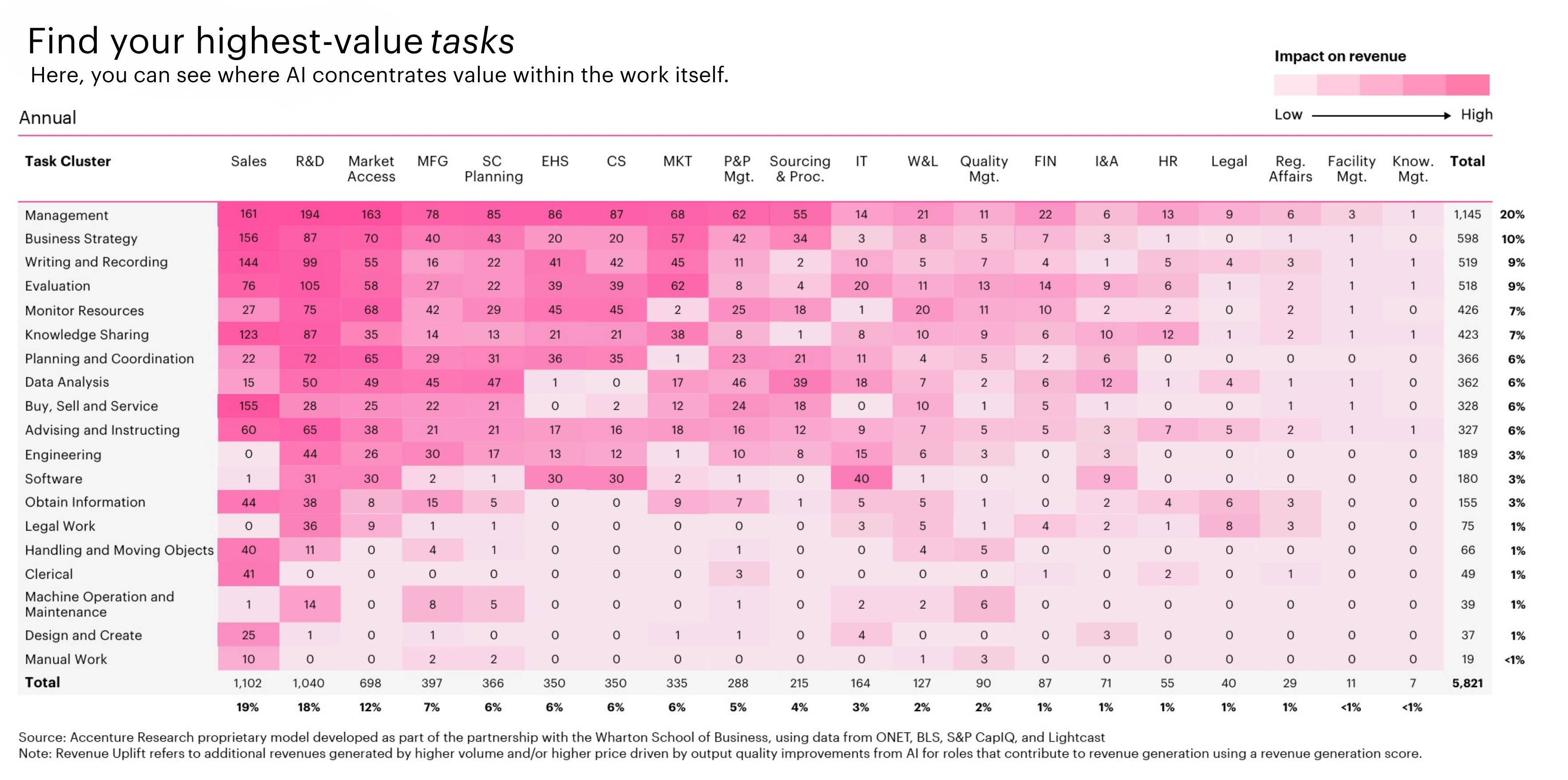
For leadership, the chart above shows that not all work contributes equally to value generated by agentic and other AI. Understanding where that value is actually concentrated—across specific tasks and the underlying skills required to deliver them effectively—can help organizations begin to align talent, time and AI efforts more deliberately around those areas. (See the full case study in our report, “The age of co-intelligence.”)
Acting on this is where many organizations get stuck. As AI creates extra capacity in the form of output or productivity, you can’t just cut headcount or costs and call that value, says my colleague Selen Karaca-Griffin, life sciences and products lead at Accenture Research.
“You need to essentially understand how to redistribute and reallocate these hours to bring growth,” she said.
That also requires a shift in how we think about talent.
Instead of managing roles, organizations need to understand the collection of skills each employee brings and how those skills can be recombined and deployed differently.
“Every employee becomes a skills portfolio manager,” Selen said. “But the second part of that is, individual contributors also become managers of various AI agents.”
This is what we describe as intelligent teaming: humans and AI working in tandem, continuously learning and adapting. Most organizations are still early in this transition.
If you want to make AI a source of growth—not just efficiency—start by asking:
Where does value actually concentrate in our business, at the level of specific tasks and activities?
How are we redeploying the capacity AI is creating to drive revenue, not just reduce costs?
Are we reshaping how work is performed across people and agents and making it both more effective and a better experience?
Are we evaluating talent through a skills lens or a roles lens?
The opportunity is to redesign work around where value is created and to align people and machines around those moments.

Learning Curve
Not all skills are valued equally
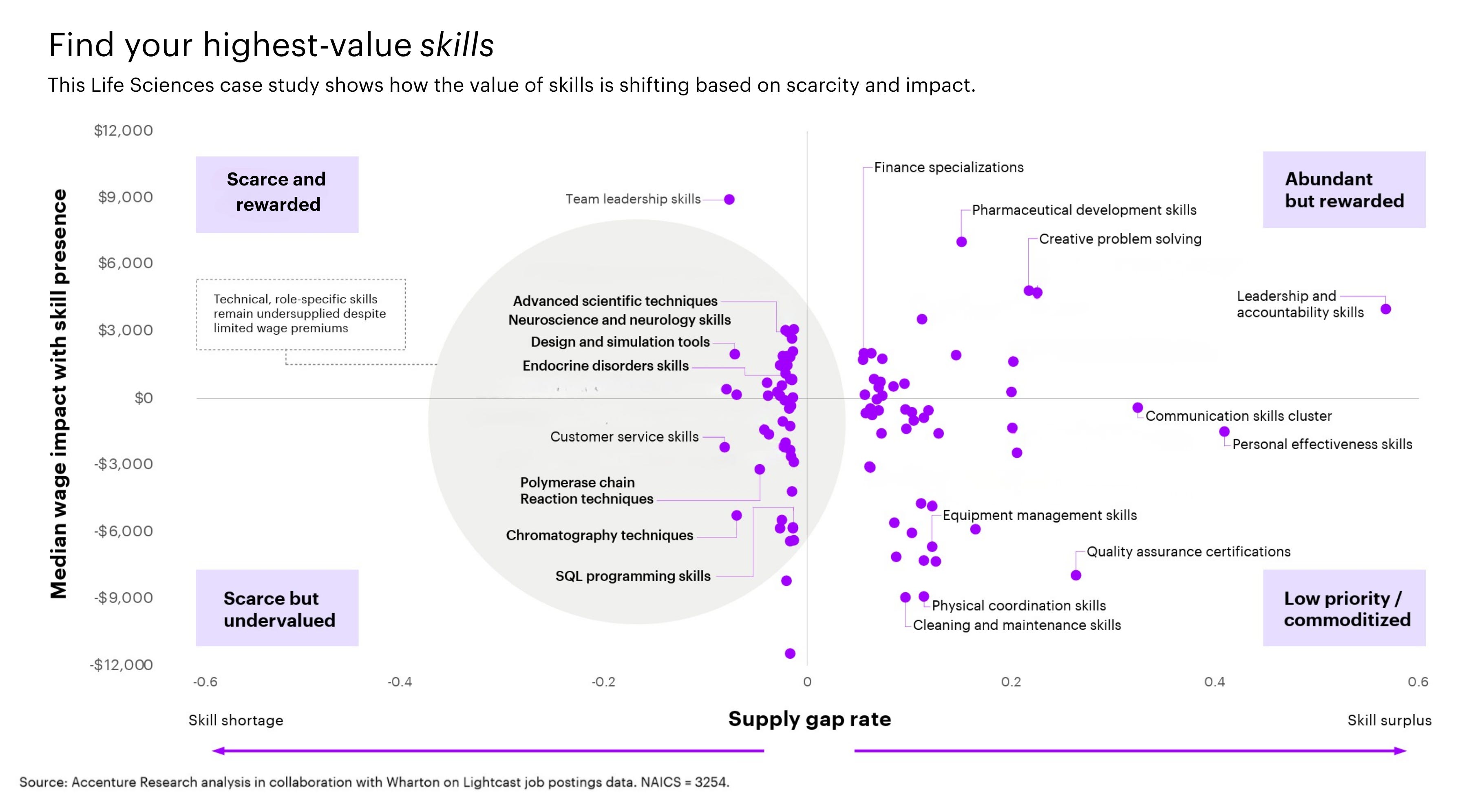
As AI reshapes work at the task level, pay is becoming less about job titles and more about the specific skills that drive outcomes. Some skills are scarce and highly rewarded, while others are widely available and add less value. That balance can change depending on the role or industry.
To make this more concrete, we looked at one industry—life sciences. This chart maps skills along two dimensions: how widely these skills exist in the workforce and how much the market rewards them.
Worth Your Attention
Anthropic has released a wave of economic reports, including one that suggests AI is not yet driving widespread job losses, but may be starting to slow hiring in certain roles. They’ve also detailed how workers are using AI for specific parts of their jobs.
A new report from Pearson shows how AI tools can help students move from passive reading to more active learning. What I find interesting here is that when used well, AI can actually deepen how students learn.
A paper, authored by OpenAI researchers, shows how AI is beginning to perform at an expert level on tasks that directly drive GDP.
Check out Accenture Research Journal, our new interactive agent that lets you explore, question and navigate the insights from the hundreds of reports we publish annually. Let me know what you find most interesting. I may cover it in an upcoming edition.
A new report from Brookings highlights how AI may reshape the career pathways that enable workers to transition from low- to higher-wage work.
Overheard
“The lesson of history is that new general purpose technologies will oftentimes automate discrete tasks or aspects of our work. And in some instances, this means that jobs will go away. In other instances, this will mean that the particular bundle of things that you do in your job will shift and new types of jobs will be created.”
— Peter McCrory, Head of Economics at Anthropic, speaking last week at the Axios AI+DC Summit
The insights above are made possible by more than 300 researchers and editors across Accenture Research, as well as by the Accenture business leaders who sponsor and shape our agenda and by my colleagues in marketing and communications who help bring these insights to life.