

The probability stack could redefine what's possible
Your competitive edge isn't just about having the right technology; it's also knowing which assumptions to test with that tech.


In this issue, I examine:
What the probability stack is and why it matters
Which business problems it was built to solve
How leaders can start using it to question old assumptions
Reading the Curve
In business, management guidelines are based around the idea that the right answer exists and the job of a leader is to find it. It’s a worldview the French philosopher René Descartes would have recognized: reason as the path to certainty, logic as the ultimate guide.
Our technology followed the same logic. The computers are viewed as “certainty machines.” They operate on fixed rules and deterministic outputs.
But there is a category of problems that this foundation was never built to handle. Not because the technology wasn’t good enough, but because, as in life, some problems don’t have a single right answer. They live in uncertainty. Demand that shifts without warning. Supply chains disrupted by events no model predicted. Drug molecules with thousands of possible configurations.
For decades, businesses have worked around these trickiest challenges. They built competitive strategies on tolerating them better than the competition.
Today, however, a new capability is emerging with the help of something called the probability stack.
This is the idea that across both software and hardware, we’re gaining the ability to compute in degrees of likelihood, rather than fixed rules, and this opens up an entirely different class of problems for businesses to solve.
As someone who has spent a career looking for what the data says beneath the surface, I’ve been tracking what the convergence of probabilistic software and increasingly powerful hardware means for the decisions that leaders make every day. To help me unpack it, I spoke with my colleagues Ari Bernstein, who leads Accenture’s Technology Vision, the annual report that tracks how emerging technology shapes business; and Prashant Shukla, Principal Director, Thought Leadership Research. Both have been researching what the probability stack means for leaders.
What struck me most in my conversations? The leaders who fall furthest behind the curve won’t be the ones who ignore these new tools. Instead, they’ll be the people who never thought to question which of their industry’s oldest assumptions might no longer hold.
And as a researcher, the question I keep coming back to is this: Can this new way of seeing the world help us finally anticipate the outliers—the unexpected disruptions, the opportunities hiding at the edges? That may be the most important question business leaders aren’t yet asking.
That’s what I set out to explore.

The probability stack is redefining what’s possible
James G. March in his seminal 1991 paper, Exploration and Exploitation in Organizational Learning reasoned that successful organizations must balance two competing imperatives: exploitation, or the refinement, efficiency and execution of what they already know; and exploration, or the search for new knowledge, experiments and the unknown.
For decades, organizations have relied heavily on exploitation because repetition builds efficiency and scale. However, the environment facing organizations today is different from the one that March described, Prashant told me.
“Specifically, the cycle times of technological disruption and competitive change have compressed dramatically,” he said. “As a result, now companies need to, perhaps for the first time, over-index on building the exploration muscle, the muscle prepared for different probabilities.”
The goal is to complement operational excellence with an equally strong probabilistic muscle. And technology is just a variable in the equation.
Our brains already know how to do this.
Probability is simply a part of how the world works. Our brains are constantly taking in information and calculating probability in real time.
Every time you glance at the sky and decide whether to grab an umbrella or size up a merge on the highway, that’s probability at work.
Those are simple calculations you’re used to making every day. Your brain can run far more complex ones without you even knowing it. Picture a professional baseball player. At the highest levels, a 96 mph fastball moves quicker than the synapses between the brain and the eyes can process. Instead, the batter watches the pitcher wind up and the brain builds a model—calculating when the ball will release, its likely trajectory, when it will arrive—and the batter swings (or not). We call it reflexes or muscle memory, but it’s something much deeper. It’s the brain running a probabilistic calculation and acting on likelihood rather than certainty.
Our brains are built for this but our machines were never built to harness this type of uncertainty. But that’s what’s changing, explained Ari.
“There is an entire side of the world, the messy unpredictable one, that we weren’t able to compute before because our machines were designed to be deterministic,” he said.
To be clear, we’re not conquering uncertainty. Rather, we’re finally building machines that can meet the world as it actually is. The challenge for leaders now is whether they are ready to see what those machines are showing them.
The problem is the lens.
The gap between what machines can do and how we’re judging them is exactly what makes the probability stack so easy to underestimate. Ari shared this famous example:
In 2016, Google’s AlphaGo was playing a grandmaster in the ancient game of Go. On the 37th move, the machine made a play so unconventional that the commentators assumed it had malfunctioned. Not exactly. That move won the game.
“If we’re only looking at it through the lens of how the game is played today, we can see some of these probabilistic outcomes and think, ‘that’s wrong, that’s a hallucination,’ the way these people reacted to that one move,” he said. “But we should be thinking, this can actually teach us how to play the game differently.”
In other words, we have been watching machines make move 37 and calling it a mistake. That’s why the leaders who pull ahead will be those who stop and ask what the machine might know that we don’t.
The assumptions your strategy is built on may not hold.
Every industry has problems so difficult that the entire competitive landscape has been built around tolerating them. In logistics, for example, it’s routing efficiency. In pharmaceuticals, it’s understanding how proteins fold to develop new drugs. In materials science, it’s understanding chemical interactions at a molecular level.
Consider a global products company whose competitive advantage rests entirely on the superior materials in what they make, using knowledge built over decades that was, until recently, nearly impossible to replicate. If a competitor can now use AI to generate and test hundreds of thousands of material compounds in the time it once took to test a handful, how deep is the global products company’s moat, really?
Ari pointed to Insilico Medicine, which used generative AI to identify and nominate promising drug candidates in 12 to 18 months on average, a process that typically takes four-and-a-half years.
“The audacity or ambition to try and tackle some of these problems is something that you should really realize is becoming a capability of the technologies,” he said.
The starting point isn’t a technology budget or a vendor evaluation. It’s a harder internal question: Which of our biggest challenges have we quietly stopped trying to solve?
This won’t happen overnight and that’s exactly the point.
The probability stack is still being built and many of its most powerful applications are still taking shape. The companies that will lead aren’t necessarily the ones moving fastest right now. They’re the ones having this conversation, who are building the understanding, revisiting their assumptions and laying the groundwork before it becomes urgent.
“This isn’t something you should expect to solve or expect to be a competitive threat tomorrow,” Ari told me. “But companies take a very long time to move. It’s not a Titanic moment yet, where you’re about to hit the iceberg. But you are leaving the dock in London without asking whether there are icebergs out there.”

Learning Curve
Not every problem needs the probability stack. Part of developing the right judgment is knowing which problems call for which approach.
The framework below, drawn directly from our research, maps problems along two dimensions: how uncertain the problem is by nature and how costly it would be to get it wrong. Where those two factors intersect tells which method to reach for.
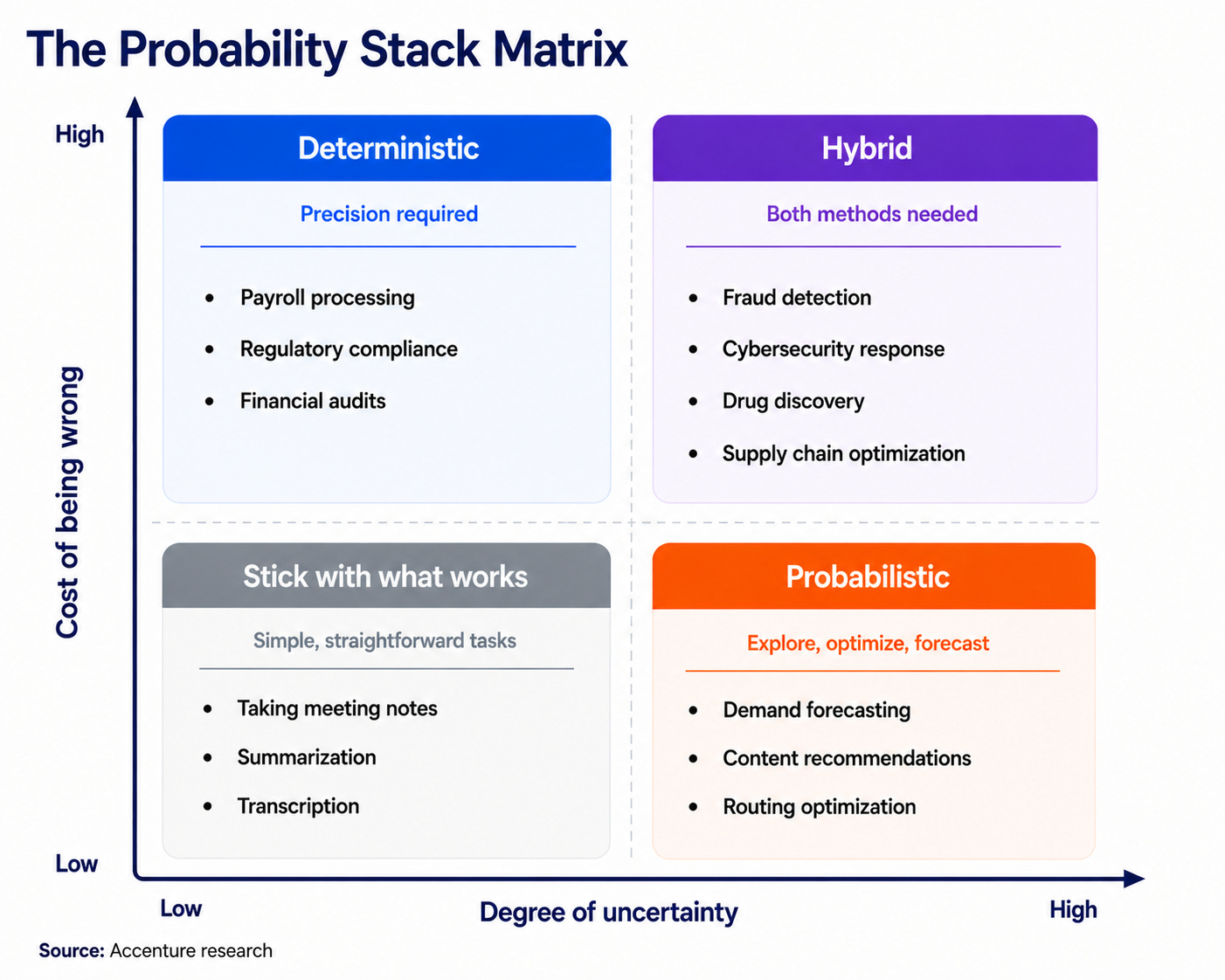
Areas like fraud detection, drug discovery and cybersecurity response are where many businesses are under-equipped because they’ve been forcing deterministic tools onto problems that were never going to yield a single right answer.
Worth Your Attention
How to get ready for quantum from California Management Review: Quantum computing is closer to practical business use than most leaders realize. This piece, by my colleagues Adam Burden, Carl Dukatz, Shreyas Ramesh and Laura Converso, makes a clear case that the window to get ready is open now. Companies, meanwhile, that wait for broad adoption to force their hand will already be behind.
Ask us anything! Head over to Accenture Research Journal, where you can query the full body of Accenture Research reports and get answers grounded in empirical findings.
Overheard
“The true winners we have seen in the past are the ones who have moved when things were still ambiguous because it allows them to set the rules of the game … Don’t wait for abundant clarity. The winners will be the ones who move faster than waiting for that ideal moment to arrive.”
— Rajat Agarwal, Commerce Lead, Accenture Song, and co-author of the new report, Agentic commerce: Make your brand unmissable
The insights above are made possible by 350 researchers, editors and AI agents across Accenture Research, as well as by the Accenture business leaders who sponsor and shape our agenda and by my colleagues in marketing and communications who help bring these insights to life.
I'd venture, with near 100% probability, that others will find this well worth reading too ... terrific!