

What executives can learn from their digital twins
The most valuable insights sometimes appear when human judgment and machine logic disagree.


Reading the Curve
Last year, I wrote about what I called a “Big Bang” moment in research. For decades, the process of generating insight followed a familiar pattern: define the question, design the survey, collect responses, analyze the results. It worked well, but it moved at the pace of weeks and months.
What caught my attention then was the emergence of agent-based research—using synthetic agents to simulate how leaders, consumers or employees might respond to a question. Insights could be generated within days, at greater scale and far lower cost.
A year later, I find myself reflecting on how quickly this shift is unfolding. At Accenture Research, we now use AI simulations with agents regularly to assess behaviors and expectations of consumers and executives. Kicking off with last year’s ”Powered for Change” report, where we tested our “human + machine” methodology, adoption of these new methods is increasing even faster than many of us anticipated.
But the most interesting questions that arise from this new way of working aren’t just around speed or scale. They’re about the additional signals we now must interpret.
In early experiments, we saw how synthetic agents answered executive survey questions differently than real leaders. At first glance, that might seem like a drawback of these new tools. In talking with my colleagues, however, we have come to see it another way.
When data-driven simulations and human judgment diverge, the gap between the two is where new insight begins to emerge.
What makes this moment even more exciting is how quickly a new ecosystem is forming around these ideas. Startups are experimenting with synthetic populations to test products, pricing and messaging before they reach the market. One such company, Aaru—founded by Gen Z entrepreneurs—has harnessed this concept to help brands use synthetic simulations to better understand human behavior. (Accenture Ventures is an investor in Aaru.)
For those of us who have spent decades working at the intersection of business, economics and technology, it’s a remarkable moment to observe.
The real questions now are not just about what these tools can do, but how leaders will learn to use them. What happens when we can test assumptions before decisions are made? And what might we learn when simulated leaders think differently than we do?
In this issue, we’re reading the curve to examine:
What executives can learn from their digital twins
Three levels of synthetic personas
An exciting beta test!

What happens when you compare human and synthetic responses side by side?
This is one of the most interesting ideas emerging from our recent work with synthetic simulations. It’s something my colleagues Gerry Farkova, a thought leadership researcher, and Vincenzo Palermo, our data science lead at Accenture Research, have been exploring closely.
At first, you might assume the goal of synthetic agents is to replicate human answers as closely as possible. But sometimes the most interesting insight appears when the two don’t match.
In some of our early experiments, we began to see how this plays out in practice. For example, when we asked executives about their hiring outlook, many expressed optimism about expanding their workforce. Yet synthetic “executive” agents working from the same prompts forecasted contractions. In another study with an external partner, executives emphasized AI as a growth engine, while the synthetic agents pointed to cost reduction.
These differences reflect the distinct nature of the two perspectives. Synthetic agents are grounded in available data and use consistent logic. Human leaders bring experience, context and long-term optimism into their decisions.
“Machines give you rational responses, while humans are unpredictable. We are the ones who can be contradictory,” Gerry said.
Rather than treating this as a limitation, the contrast between the two can reveal signals that traditional research alone might miss.
This creates a powerful hybrid approach to research. Instead of relying on a single dataset, researchers can now compare multiple perspectives—what people say, what simulations predict and what the gap between them reveals.
A mindset shift
For business leaders right now, it’s all about efficiency: doing it fast and cheap.
“Everyone will be able to do simulations faster with synthetic agents. So, long-term, the real competitive advantage is in changing how we’re asking the questions,” Vincenzo said.
The edge will come from knowing how to question the outputs and recognize when the answers deserve closer scrutiny.
That’s where the value of the hybrid approach begins to show up in practice:
Testing leadership assumptions: Executives may express strong support for a strategy, while a simulation suggests adoption may be slower in practice. The gap can highlight operational barriers before resources are committed.
Understanding intent versus behavior: Consumers often say they will adopt a product or service, yet purchasing data tells a different story. Simulations trained on behavioral data can reveal this difference early.
Revealing hidden risks: Humans bring their biases—a tendency toward optimism or toward the dominant discourse—while simulations are grounded in available data points. Examining the gap can surface risks that leadership teams may be underestimating.
For researchers, this means thinking about how insights are generated differently.
“Sometimes, you’re looking to figure out what you’re missing, for example, because of bias. Then it’s good to look for the gap and figure out what it can tell you,” Gerry said. “That’s what makes it exciting. Now I’m working with a lot more data points. I’m triangulating.”
Staying grounded in the real world
As powerful as these simulations are becoming, they also reinforce the need for real human understanding.
“Regardless of where it goes, you still need to know your own consumer rather than just looking at synthetic results, no matter how precise they are,” Vincenzo said. “Because it’s that actual connection of knowing that allows you to trust the synthetic responses.”
For leaders, synthetic simulations will make it easier to generate insights. But the key advantage will come from knowing how to interpret them: when to trust the signal, when to question it and how to combine it with real-world insight.
In uncertain environments, that kind of discernment may become one of the most valuable capabilities organizations can build.
What questions could synthetic agents help your organization answer? I’d be interested to hear how you’re thinking about this.

Learning Curve
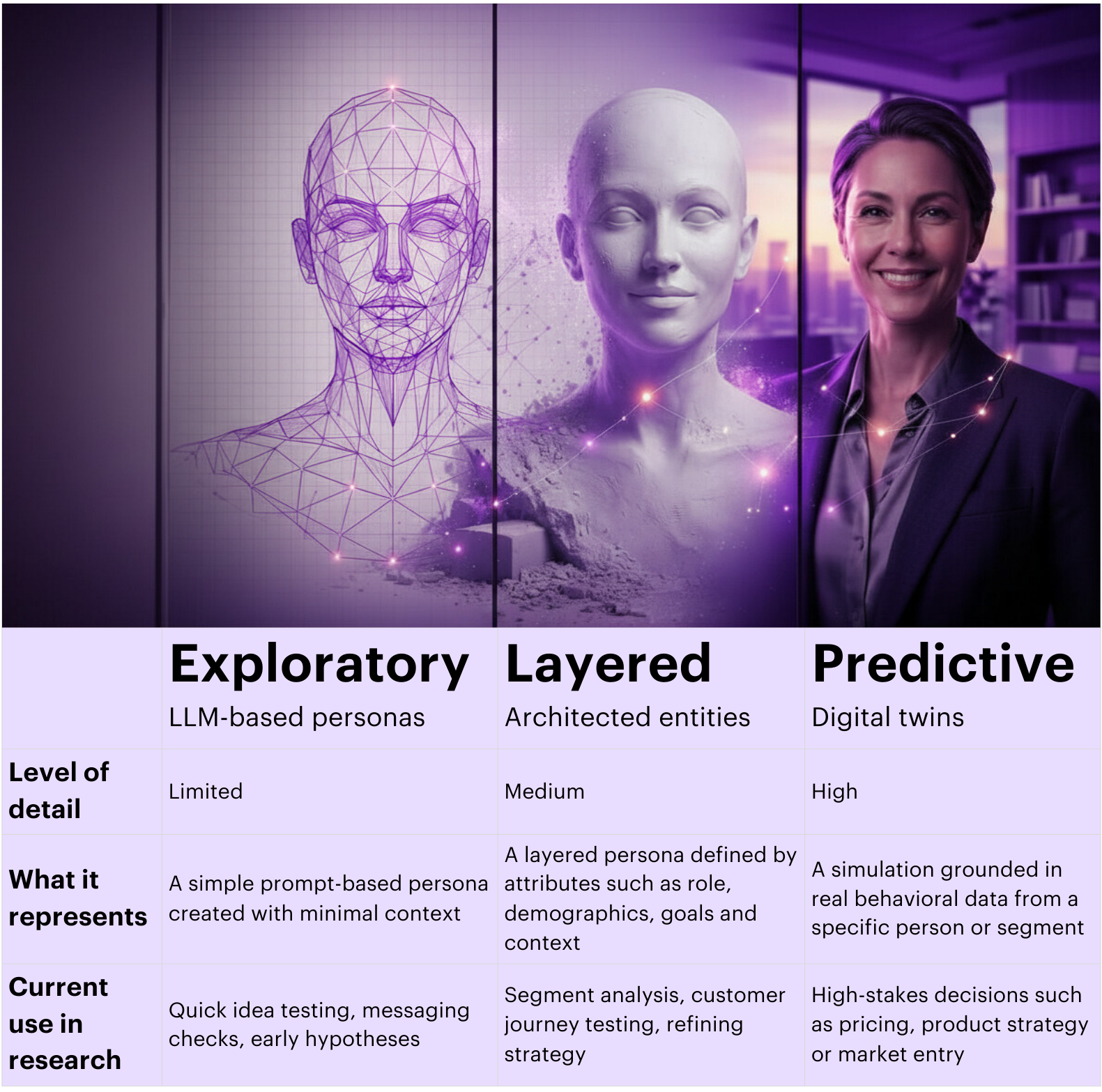
What type of synthetic model is appropriate for different decisions?
Synthetic personas are rapidly evolving from simple narrative constructs into powerful decision systems. But not all persona approaches are created equally.
Accenture Research’s framework shows how leaders can choose the right level of simulation depending on the strategic decision at hand.
Worth Your Attention
I’m excited to announce that the Accenture Research Journal is now live. We are testing a new interactive agent that lets you explore, question and navigate the insights from the hundreds of reports we publish annually. Be part of our research; check it out and let me know what you find most interesting. We may cover it in an upcoming edition!
“Acceptance Is Not Enough: Toward a Psychology of Calibrated GenAI Use”: This new research article (PsyArXiv), from Nicolas Bassan, Louise Blart, Charles Ayoubi and my research colleagues Sandra Najem and Philippe Roussiere, reveals that acceptance of generative AI doesn’t necessarily lead to effective use, and that using the technology well doesn’t always lead to higher acceptance; the two (use and acceptance) rely on different skills and mindsets. For organizations, this means unlocking real value from gen AI requires deliberately developing both the right skills and mindsets.
“2026 DHL Global Connectedness Report”: Steven Altman from NYU just published new data showing that the world is not disconnecting; its connections are evolving instead.
“The Running Ground” by Nicholas Thompson: Nick, CEO of The Atlantic, recently published a terrific memoir on running (“the simplest of sports”). The book moved me because it connects the sport that I practice earnestly, albeit at a much more modest level than Nick, with other important parts of his life (and my own). After reading it, I even incorporated beet juice into my training regime.
Overheard
“Employers will be looking for social skills. They’ll be looking for capacity to learn new things. The ability to interact with a range of people and be effective in unfamiliar situations. They’ll also be looking for grit and determination.”
— Joseph B. Fuller, Harvard Business School Professor and founder of the Managing the Future of Work project
The insights above are made possible by more than 300 researchers and editors across Accenture Research, as well as by the Accenture business leaders who sponsor and shape our agenda and by my colleagues in marketing and communications who help bring these insights to life.
The interesting part isn’t the agents. It’s the gap becoming a primary signal.
This shifts research from finding answers to testing belief systems. When executive optimism diverges from synthetic outputs, the task isn’t to pick a side. It’s to identify where incentives, narratives, and data are misaligned.
What happens when leaders start managing to that gap? It could change how strategy gets justified internally.