

When agents do the shopping
What agentic commerce means for your business, from three different angles.


In this issue, I examine:
What agentic commerce demands of businesses
The two paths every company must consider (most are only pursuing one)
Why personal relevance is becoming a competitive advantage
Reading the Curve
Digital commerce has delivered on many of its original promises. Shopping is faster, more convenient and available at any hour. And yet, anyone who’s tried to book a transatlantic flight with the family cat knows the experience can still unravel quickly. You find the right flight, but then you find the pet policy buried in an FAQ that’s different on every airline, with a cabin limit nobody advertises clearly. You call to confirm. You get transferred. You start over.
Given how far we’ve come, this complexity shouldn’t still exist.
That gap between what digital commerce promised and what it actually delivers is what makes the latest research from our team worth paying attention to. As one of my colleagues put it, digital commerce has largely been tolerated. It’s certainly not loved. Now, the architecture of commerce itself is being reconsidered.
To understand what this change means operationally, I spoke with three of my colleagues at Accenture Research who approach this issue from very different angles: payments, trust and the broader commercial landscape.
What struck me most is that while each of them is looking at a different part of the problem, they all arrive at the same conclusion: We are at another genuinely transformational moment in commerce, one that rivals the earliest days of e-commerce in its scope. Businesses that move now will have a real advantage.

Your next customer might be a machine
Nearly three decades ago, businesses had to rebuild for the internet age. New storefronts, new logistics, new ways of reaching customers. Companies that moved early defined their categories.
The shift underway now has a similar shape, except that the new customer arriving at the door won’t always be a human browsing a website. It could be an AI agent acting on someone’s behalf, with no patience for friction and no emotional attachment to your brand.
Agentic commerce is the term for what happens when AI agents—software systems that can reason, plan and act autonomously—take over some or all of the steps involved in finding, evaluating and purchasing goods and services on behalf of an individual or organization.
To help me unpack the implications for brand leaders, I spoke with Josh Bellin, who leads research on customers and growth at Accenture and who co-authored the new report, Agentic commerce: Make your brand unmissable; Hannes Fourie, Accenture’s global payments research lead; and Surya Mukherjee, a researcher who has been examining trust and the human dimensions of AI adoption.
Here’s what they told me:
1. The opportunity is bigger than most companies realize
Today, a human browses, compares and clicks. In an agentic environment, that entire process can be delegated. And that delegation changes everything about how businesses need to show up.
There are two distinct ways to respond to this shift and most companies are only thinking about one.
The first is becoming the “choice of agents”—ensuring your products and services are visible, structured and compelling enough that AI agents find and recommend you. “You want to be the solution to a problem. It’s no longer just, ‘how do I show up in search?’” Josh said.
The second is becoming the “agent of choice”—building your own agent that serves your customers directly. Companies with deep category authority, rich first-party data and the ability to orchestrate end-to-end commerce are best positioned to own that second path. But most aren’t there yet.
Josh pointed to an example that illustrates the agent of choice scenario well. Think about a major skincare brand. These companies already possess deep category expertise and deep consumer trust. In an agentic environment, that combination becomes a genuine strategic asset.
As Josh told me, a customer might share a photo of their skin with a brand’s agent, describe what’s bothering them and ask what they need. Or they might return to an agent that already knows their history. It could go something like this: “We’ve talked about my itchy scalp before. Do you have a product that can soothe it?”
The brand is no longer just a product on a shelf. It becomes the trusted guide that helps a customer understand their own needs.
This is exactly the kind of experience that generates net new demand. Our research in partnership with Aaru, which simulated 50,000 synthetic consumer agents across 24 countries, suggests that agentic commerce will generate entirely new buying moments that did not previously exist. Indeed, within 18 to 24 months, a majority of consumers are projected to complete purchases inside AI conversations that didn’t start with an intent to buy.
The agent-assisted purchasing journey will begin with a consumer sharing their need before they even know exactly what they want or whether buying is the answer. As a result, the total number of buying moments for the average consumer is expected to expand.
Not every industry will feel this shift in the same way or at the same pace. The chart below maps industries by two variables: the net-new demand agents are expected to generate and the execution risk organizations face in meeting it.
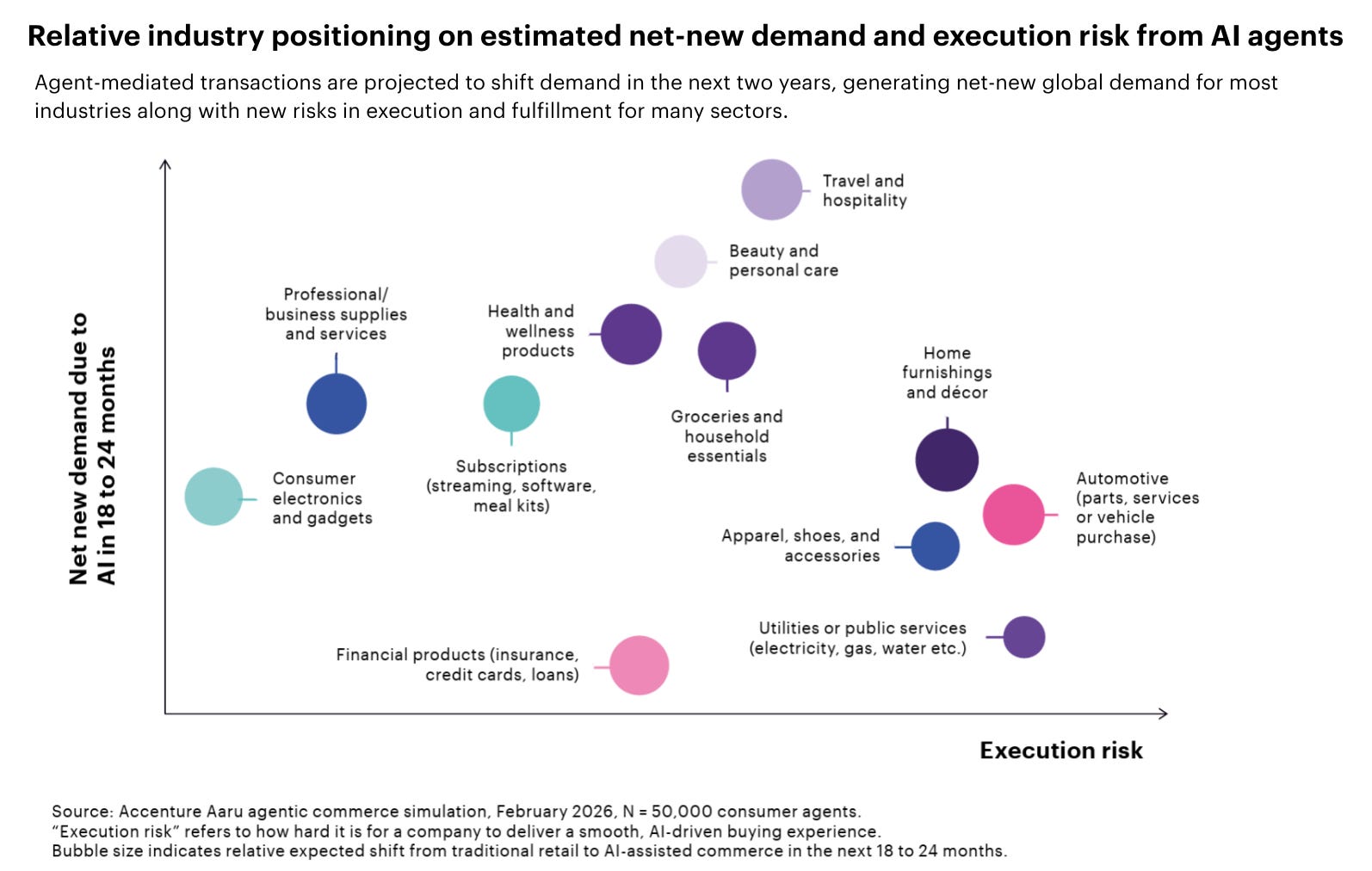
The demand side gets most of the attention. But business leaders should study the execution risk axis, too. In categories like travel and health and wellness, the ability to deliver on inventory, payments, fulfillment and customer service will determine whether an agent recommends you or moves on.
2. The back end is now a front-line issue
Most conversations about agentic commerce focus on visibility; that is how to get found and how to get recommended. Hannes redirected my attention to what happens at checkout.
In an agentic environment, the checkout page as we know it effectively disappears. An agent that has already found the right product, compared options and verified availability will also select the best payment method. It can optimize rewards, speed, cost and trust on the buyer’s behalf.
“The decision layer is moving up,” explained Hannes. Payment is no longer the last step a human takes. It’s one more variable an agent manages.
Because the agent already knows you and has your payment credentials and even your loyalty points, it can optimize a transaction in ways a human shopper might not think to do. It might apply store points you forgot you had, route the payment through the most cost-effective method or surface a discount tied to your account.
This has significant implications for payment providers, merchants and any business that processes transactions at scale. For example, merchants currently pay around 3% in fees when a credit card is used for a purchase. But in an agentic environment, an agent could route a transaction through a bank transfer or account-to-account payment, saving the merchant money and potentially passing some of those savings on to the customer.
The businesses that act now will have a real advantage. “If your payment is not discoverable, your volume might decline,” said Hannes. “Therefore your revenue from payments declines.”
The risk goes beyond revenue. If your brand isn’t showing up at the agent layer, customers may simply stop thinking about you altogether.
The fraud question is equally urgent. Agents can shop at any hour of the day or night. They can transact across time zones and at a volume and frequency no human can match. Early research from Accenture indicates that a significant majority of financial and payment leaders already expect fraud to increase with agentic payments and that most are still relying on standard workflows to investigate fraud.
“Banks and payment companies need to rethink everything around authorization,” added Hannes. “The sheer amount of transactions will be more and they could happen outside of regular business hours. That’s the power of what agents will bring to this.”
3. The most valuable thing a brand can do now is make its audiences feel seen
Surya has been researching the issue of trust in AI: how it forms, what breaks it and what it requires of organizations trying to build it. He and his colleagues identified something that most businesses entirely miss.
Trust in AI, they argue, isn’t one-dimensional. It has several dimensions.
There is a rational, cognitive dimension: Can the agent do what a competent human would do? Get the answer right, execute the task accurately.
There is a safety dimension: Is my data secure? Is the system behaving within appropriate boundaries?
Most enterprise AI systems are built around these two dimensions. They are necessary, but they aren’t sufficient.
There is a third dimension that companies consistently overlook: the emotional dimension of trust. The sense that the agent genuinely gets you without being creepy. “We used to call it relevance,” Surya said. “But it’s morphing more into the territory of being seen, heard and understood.”
This matters enormously in an agentic environment. As agents handle more routine tasks, such as browsing, comparing and transacting, the moments when a consumer engages directly with a company become fewer. Yet those moments become far more intentional. A customer who shows up in the agentic era isn’t browsing; they’re there for a reason.
“To win in these moments, you must double down on things like intimacy, relevance, experience,” Surya said. Companies that show up with genuine personal relevance will build the kind of trust that both people and agents learn to recognize.

Learning Curve
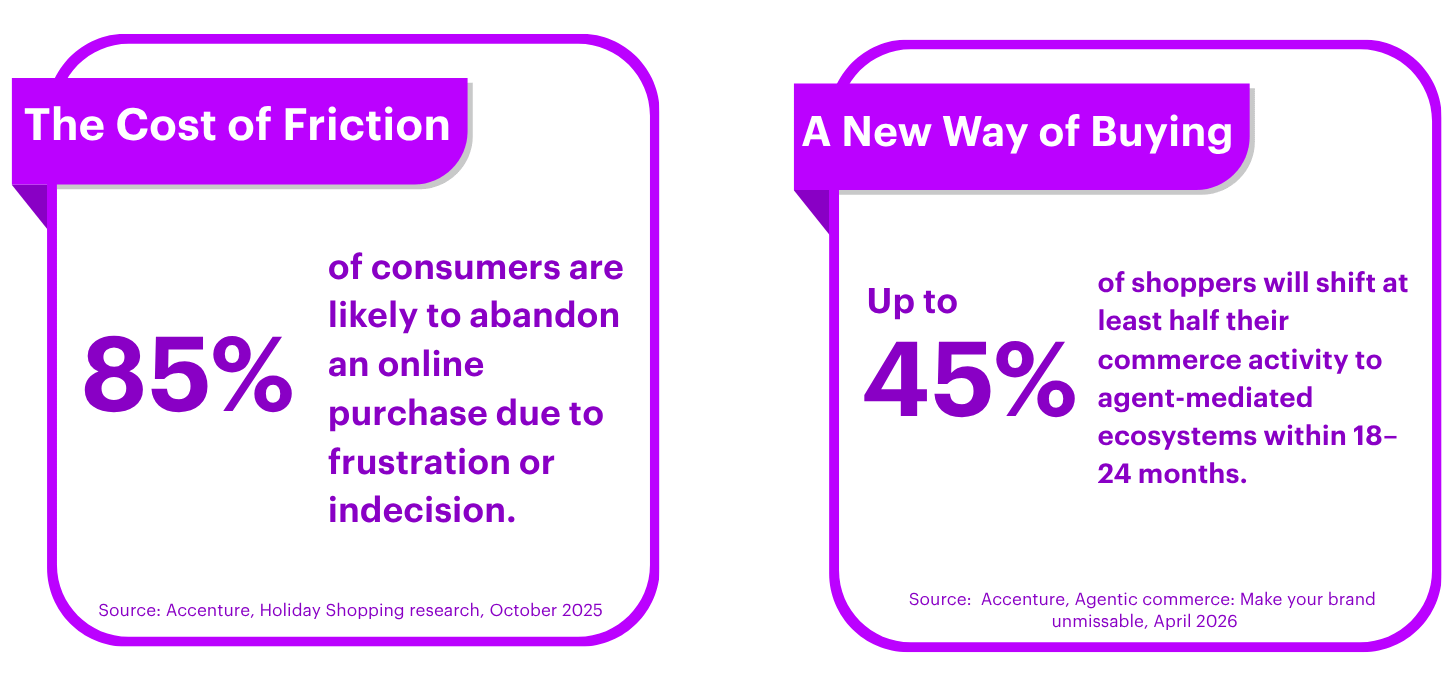
Digital commerce has always had a patience problem: The majority of consumers are likely to walk away from an online purchase because of frustration or indecision, according to previous research by Accenture. That number has been sitting quietly in the background for years. It’s accepted as the cost of doing business online.
Agentic commerce has the potential to change that. Agents don’t get frustrated. They don’t get overwhelmed by options. They just execute.
That’s why businesses need to determine now if they’re ready for what’s coming before the old model fully breaks down.
Worth Your Attention
An anecdote about angling with AI technology caught Surya’s attention. In this podcast, Wall Street Journal contributor Ken Wells recounts how technology changes the nature of skill, intuition and discovery in sport fishing. Surya recommends it as an unexpected lens on where AI and personalization are heading.
Josh recommends What we lose when artificial intelligence does our shopping. This piece, from Mark Bartholomew, Professor of Law at the University at Buffalo and Samuel Becher, Professor of Law at Victoria University of Wellington, is a useful collection of links that deepen the questions we can ask about the future of agentic commerce.
Ask us anything! Head over to Accenture Research Journal, where you can query the full body of Accenture Research reports and get answers grounded in empirical findings.
“It is much easier to give Gemini five pictures of clothes you like than to describe your dressing style.”
— Vidhya Srinivasan, Google’s vice president and general manager of advertising and commerce, in Fast Company
The insights above are made possible by 350 researchers, editors and AI agents across Accenture Research, as well as by the Accenture business leaders who sponsor and shape our agenda and by my colleagues in marketing and communications who help bring these insights to life.