

Where AI is actually earning its keep
Four months after our inaugural emerging tech ranking, we look at what shifted and what surprised us.


In this issue, I’m reading the curve to examine:
Where the business value is moving in the AI stack
What’s closing the trust gap
The human skill that AI still can’t replace
Reading the Curve
As researchers, we live for the moments when a signal bubbles up out of the noise. For the work we do, this could be when a technology turns out to be quietly reshaping how an entire discipline works.
That was at the heart of why we built our emerging tech rankings. We wanted a holistic view of where the AI landscape was shifting, but also the ability to examine what that view might be leaving out: the gaps between what one community is building and what another is studying or buzzing about, at the very same moment.
We introduced the inaugural rankings several months ago, based on research we conducted in December. The concept was to track core technology domains across three places where we know these signals are beginning to surface, but for different reasons: ArXiv, where early research and innovation get discussed and captured; GitHub, where code is built and deployed; and Hugging Face, where models and tools enter practice.
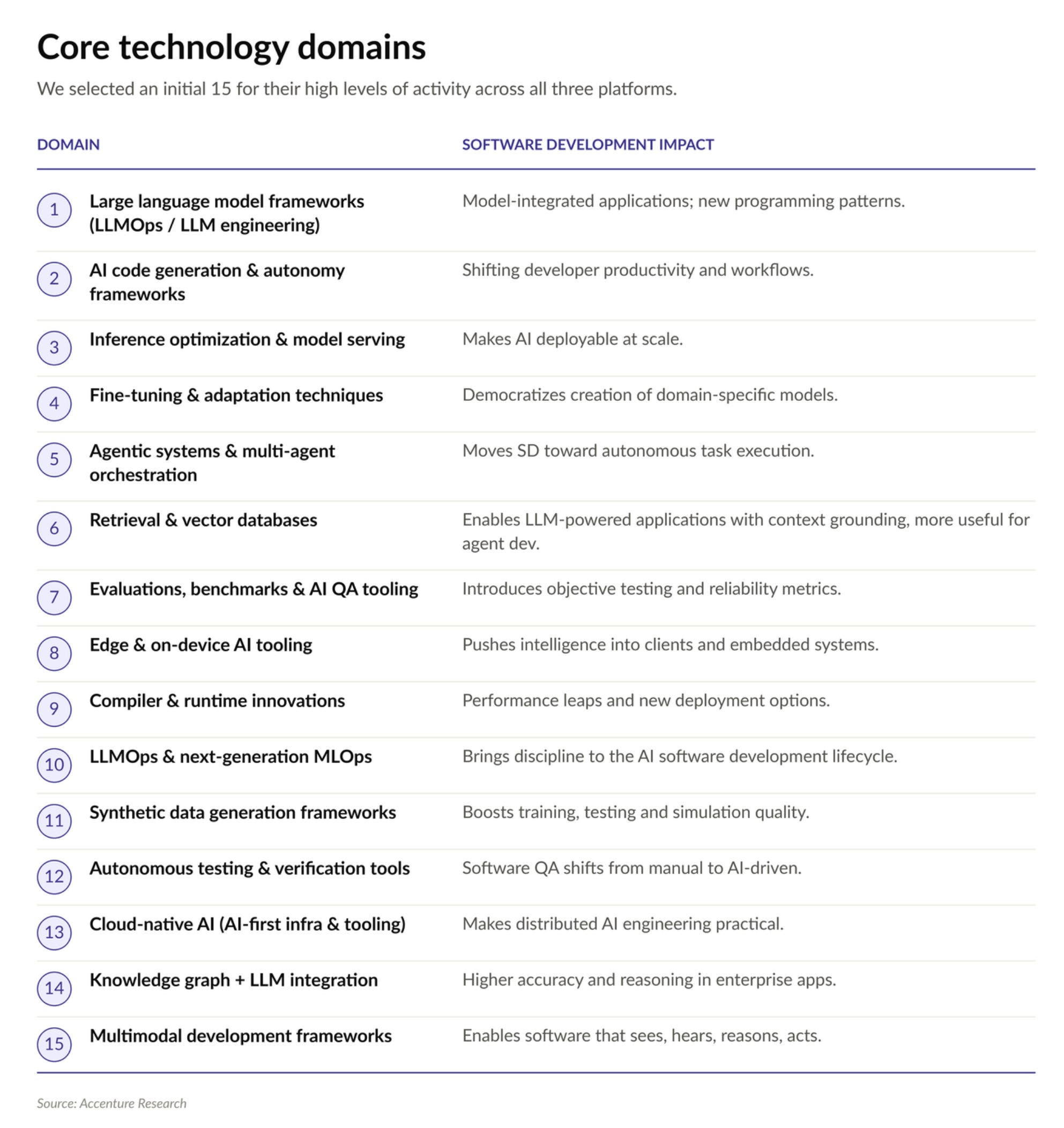
Our first ranking was our baseline. Large language model (LLM) frameworks and model engineering sat at the very top, dominating the stack from the start.
We also saw that classic computing was being rewired for AI, where half the technologies on the list were decades-old disciplines being reinvented for a new era. Databases, compilers and testing frameworks—the machinery underneath every system—were showing up as infrastructure being redesigned for how AI runs.
We saw that the ranking read less like a leaderboard than an architecture, with capabilities at the top, connecting systems in the middle and infrastructure underneath.
And we noticed a trust gap. Technologies that build capability consistently outranked those that make that capability reliable, accurate and explainable. This left us wondering whether we were building these systems faster than we were learning to verify them.
Four months on, some of these threads are starting to take a direction.
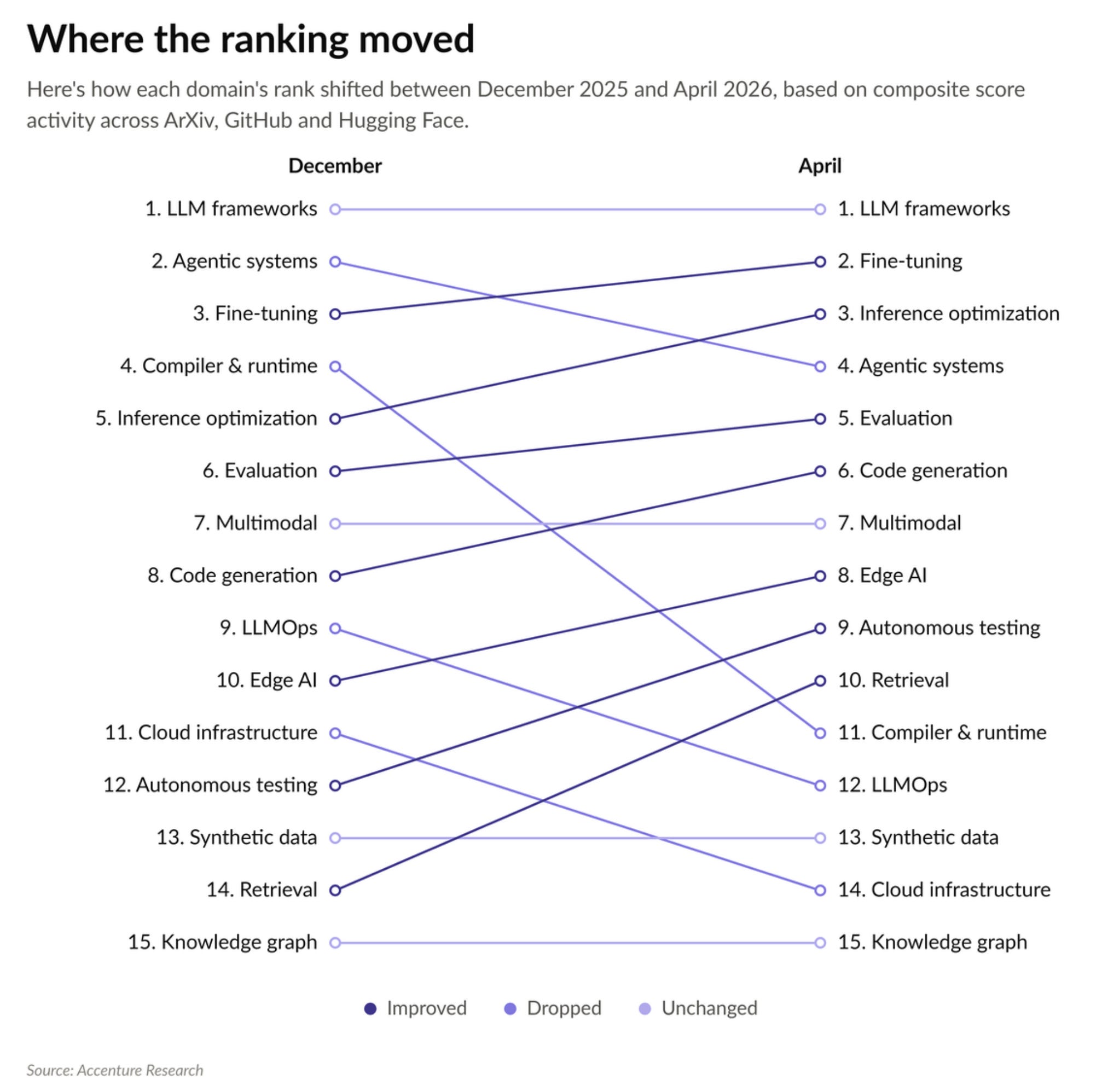
The first is what my colleague Jim Wilson, whom I asked to join me on this post, calls the “last mile.” LLM frameworks holding the top spot across every platform signals a kind of standardization. This means that the real differentiation for enterprises has moved downstream, to the work of tailoring a model to a company’s own data and processes.
The second direction relates to a question we asked back in May: would testing, evaluation and governance start to climb as companies pushed toward production, or would that gap just keep widening? Four months on, we have a clearer read and it’s encouraging.
And the third direction connects to what these developments mean for the people doing the work. As AI tools take on more tasks, the judgment that matters most may be in the kind of tacit knowledge about a business and its culture—risk tolerance, for example—that no machine can supply.
So if the baseline rankings were about mapping where things stood, this next edition is about watching that map begin to move.
To help us make sense of it, I sat down again with Jim, who is Accenture’s global managing director of IT research, along with Shruti Shalini and Rhine Andotra, the researchers whose work built the rankings. I’ll let them take it from here.

AI is moving from pilot to product
Jim here with my Accenture Research colleagues Rhine and Shruti. When we first proposed this ranking, the idea was to build something almost like a real-time monitor from the front lines of tech: a monthly, or even weekly, pulse check on what’s rising and falling across the platforms where technology actually gets built. The thinking was, if a technology jumps to the top of the ranking one month and drops the next, that movement itself is a story and we could talk about why in near-real time.
Two rounds in, it turns out the more interesting story isn’t the week-to-week churn. It’s the slower pattern taking shape underneath all the headlines and hype. We’re starting to see how these technologies shift and recalibrate against each other and we can begin to paint a picture of where organizations are placing their bets and where their real needs lie.
Which brings us to our first topline takeaway. The obvious observation is that LLMs remained at the top of the leaderboard. But the more interesting story, I’d argue, is the movement just below it. That’s where companies stand to gain real advantage.
Increasing focus on the “last mile”
By last mile, I mean something specific: AI is becoming an actual tool you use, not just a system you’re testing. And there are a couple of strong signals pointing to that.
The first is retrieval and vector databases (#10), which jumped from #14, the biggest single move in the entire rankings. Think of retrieval and vector databases as the working memory and search of an AI system. If you’re going to run one of these systems on your own data, you need a way to search that data and you need somewhere for the system to hold onto what it’s learned. That’s what this technology does. It’s a strong signal that agentic systems aren’t just being piloted anymore; they’re also being integrated into how companies run.
The second signal is autonomous testing and verification tools (#9), which also climbed several spots, from #12. If you’re going to have these systems running inside your company, you need quality assurance around them, the same as you would for any product you ship. These testing tools have existed for a long time as programming tools. But the fact that they’re two of the biggest risers in this ranking tells me that companies are moving agents into real practice, not just running them in a sandbox.
We actually saw a version of this play out in our own operations. In one pilot, we found that if you want agentic AI to succeed, it needs a way to learn. Otherwise, it just creates more work than it saves. Getting that right also took investment in retrieval and evaluation together.
There’s a companion story here in what dropped: compiler and runtime innovation (#11), which fell sharply, from #4. My read is that this isn’t a sign that compilers matter less. It’s that we’re moving past the phase where most of the work was building the agentic system itself, largely a compiler’s job, and into the phase where the work is running it well in the real world. That’s exactly what retrieval and autonomous testing are for.
Put together, this is what I mean by the last mile. The great value is in the tailoring: fine-tuning (#2) models to your company’s own data, optimizing inference (#3) for your specific workflows and evaluating (#5) whether the system is performing by the standards your company cares about.
For leaders, this suggests the real question isn’t just about which model you’re using, but how much work you’re putting into making it yours.
The trust gap is starting to close
Back in May, we asked whether the technologies focused on testing, evaluation and governance would begin to climb as companies pushed AI systems toward production or whether that gap would widen. Four months later, we are starting to see an answer.
Evaluation, benchmarking and AI quality (#5) is now the number one topic on ArXiv, displacing compilers as academia’s leading focus. It also climbed from 12 to 5 on GitHub. Indeed, it’s one of the few categories in this dataset, along with Autonomous testing and verification (#9) and Retrieval and vector databases (#10), that moved upward on every platform simultaneously. When an upward movement shows up across all platforms at the same time, it’s harder to dismiss it as a passing trend. In this case, it signals a shift in focus toward the engineering layer that supports and builds agentic systems and LLM frameworks.
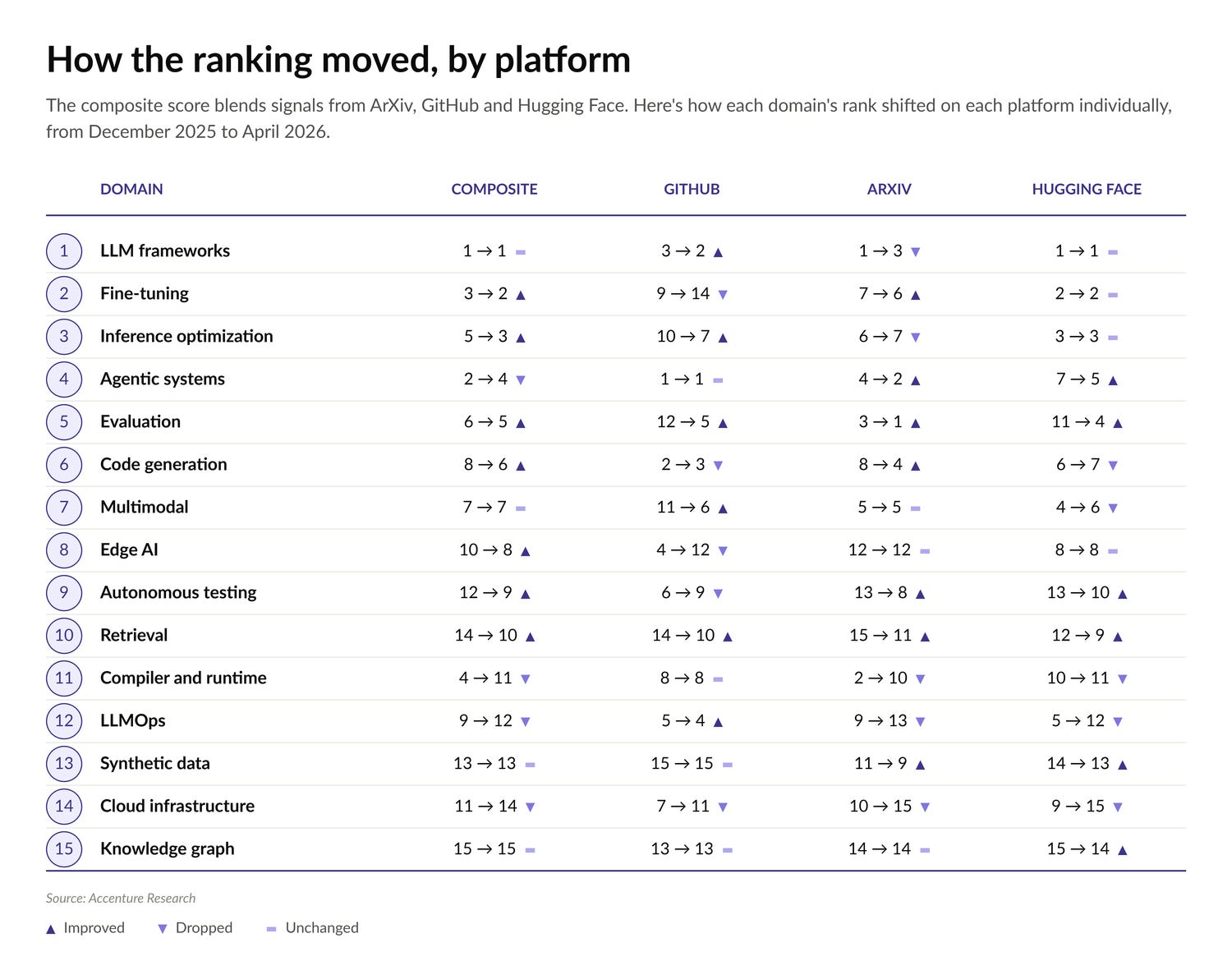
That cross-platform alignment is also worth understanding. As Rhine observed, there’s a pattern to how these two communities relate to each other. GitHub, where developers build things, tends to run ahead of ArXiv, where academia writes about those things. As developers build and run into roadblocks, academia picks up on those issues. That’s our read on what could be happening here. As agentic systems moved from prototype into production, reliability became the roadblock that everyone hit and academia converged on it. What’s new this time is that developer tooling is now visibly catching up too. The gap between what we build and what we can verify hasn’t closed completely, but it’s closing from both directions at once.
For leaders, the implication is that evaluation and testing are not disciplines that you bolt on after a system is already live; the organizations that are furthest along in putting agents into production are, not coincidentally, the same ones that are now investing seriously in the means to verify them. If you’re moving fast on capability, this is the moment to be moving just as fast on the means to trust what you’ve built. (We’ve written more on what that looks like in our responsible AI edition.)
The skill gap AI can't close
Last, something that isn’t quite a formal reading of the rankings, but it’s nevertheless a perspective that I find genuinely interesting.
With AI code generation (#6) moving up a couple of spots, someone who just got their computer science degree might be wondering what their workflow looks like, now that Claude Code can do a lot of what they trained for. My honest answer: you’re going to spend more time learning how your organization creates value and then doing the fine-tuning, inference optimization and evaluation work we talked about above.
Companies have traditionally hired early-career programmers for certain skills, like fluency in Python or Java, but AI systems are now automating many of those workflows, thus shifting the bundle of tasks that humans perform. Where AI still has progress to make is in the tacit dimension—understanding what matters to your customers, what resonates with your business leaders, how your company actually competes. That comes from being embedded in an organization.
Take autonomous testing, one of the biggest risers in this ranking. Whether a company leans on it lightly or heavily isn’t really a technical decision; it’s a reflection of that company’s appetite for innovation and tolerance for risk. The person running that testing needs a real feel for where their own company sits on that spectrum. That’s tacit knowledge and no system supplies it on its own.
As we continue to follow how these technologies rise and fall, we’ll be watching this thread too, not just where the tools are headed, but what they’re asking of the people using them.

Worth Your Attention
From AGI to ASI: A worthwhile read from a team that includes Shane Legg, a Google DeepMind co-founder, on what might come after artificial general intelligence.
Deep Utopia: Nick Bostrom's earlier book, Superintelligence, asked what happens if AI goes wrong. This one flips the question: what happens if it goes right?
Crashing Waves vs. Rising Tides: Backed by thousands of worker evaluations, this MIT paper argues that AI progress looks less like sudden breakthroughs and more like a rising tide, gradual, broad and already well underway.
For a deeper look at what these emerging technologies mean for business, explore the Accenture Research Journal, where you can access the full scope of Accenture Research reports, all grounded in empirical findings.
Overheard
“There is nevertheless going to be a lot of churn ... It’s not all going to be, ‘AI is a tool that makes us all better’ or ‘AI is a tool that devalues all of us.’ It’s going to be a mix of things. Some occupations, one, and some occupations, the other. But there is going to be a lot of movement, where particular occupations change.”
— How AI Will Reshape Jobs Instead of Replacing Them, from Neil Thompson speaking at TEDxBoston
The insights above are made possible by 350 researchers, editors and AI agents across Accenture Research, as well as by the Accenture business leaders who sponsor and shape our agenda and by my colleagues in marketing and communications who help bring these insights to life.
Thank you for sharing this thoughtful article. AI can be a valuable tool when it is used with wisdom, integrity, and discernment. Technology should never replace human relationships, compassion, or dependence on God, but it can be used to serve others, solve problems, and support meaningful work. Proverbs 3:5-6 reminds us to trust in the Lord with all our heart and not lean on our own understanding. James 1:5 encourages us to ask God for wisdom, and He gives it generously to those who seek Him. Colossians 3:23 reminds us to work wholeheartedly, as working for the Lord and not merely for people. Every gift, skill, and tool we have should ultimately be used for God's glory and the good of others. Thank you again for sharing this insightful perspective. May the Lord give us wisdom to use every opportunity and every technology in ways that honor Him, serve people with love, and advance His purposes. God bless you.