

What happens when the checkout window goes away?
As AI agents take over more of customers’ purchase journey, the loyalty and trust that businesses spent years building will face a new kind of test.


In this issue, I’m reading the curve to examine:
Why the loyalty that brands built may not survive the agent layer
How the relationships between consumers and payment providers is changing
What it will take for brands and banks to remain relevant in an agent-driven market
Reading the Curve
In a recent edition, we introduced the idea of agentic commerce and what it means when AI agents acting on behalf of consumers find, evaluate and choose brands. We explored how the agent layer is reshaping discovery and brand visibility and why connecting with a machine requires a form of trust that machines and humans earn in different ways.
This edition goes deeper into what happens at the moment of purchase and what it means for the loyalty businesses have spent years building.
A simple way to think about what’s changing is to consider how you pay for something today. When you shop online, you probably already know how you’re going to settle up. You add your items to the basket, head to checkout and select your card, Apple Pay or even points, press “place order,” et voila. One to three business days later you’ll receive your package.
That process sounds simple, but it rarely feels that way. Our 2025 holiday shopping research found that 85% of shoppers say they’re likely to abandon their cart altogether out of frustration or indecision. As shoppers, we’ve adapted to this.
In an agentic environment, the checkout page, as we know it, effectively disappears. That final decision to “place order” isn’t there for you to make in the moment.
The agent makes it, optimizing across your payment options, rewards, points, or even financing methods you may not have considered, such as buy now, pay later. That shift has consequences that reach beyond just the payment itself. It touches everyone in the transaction.
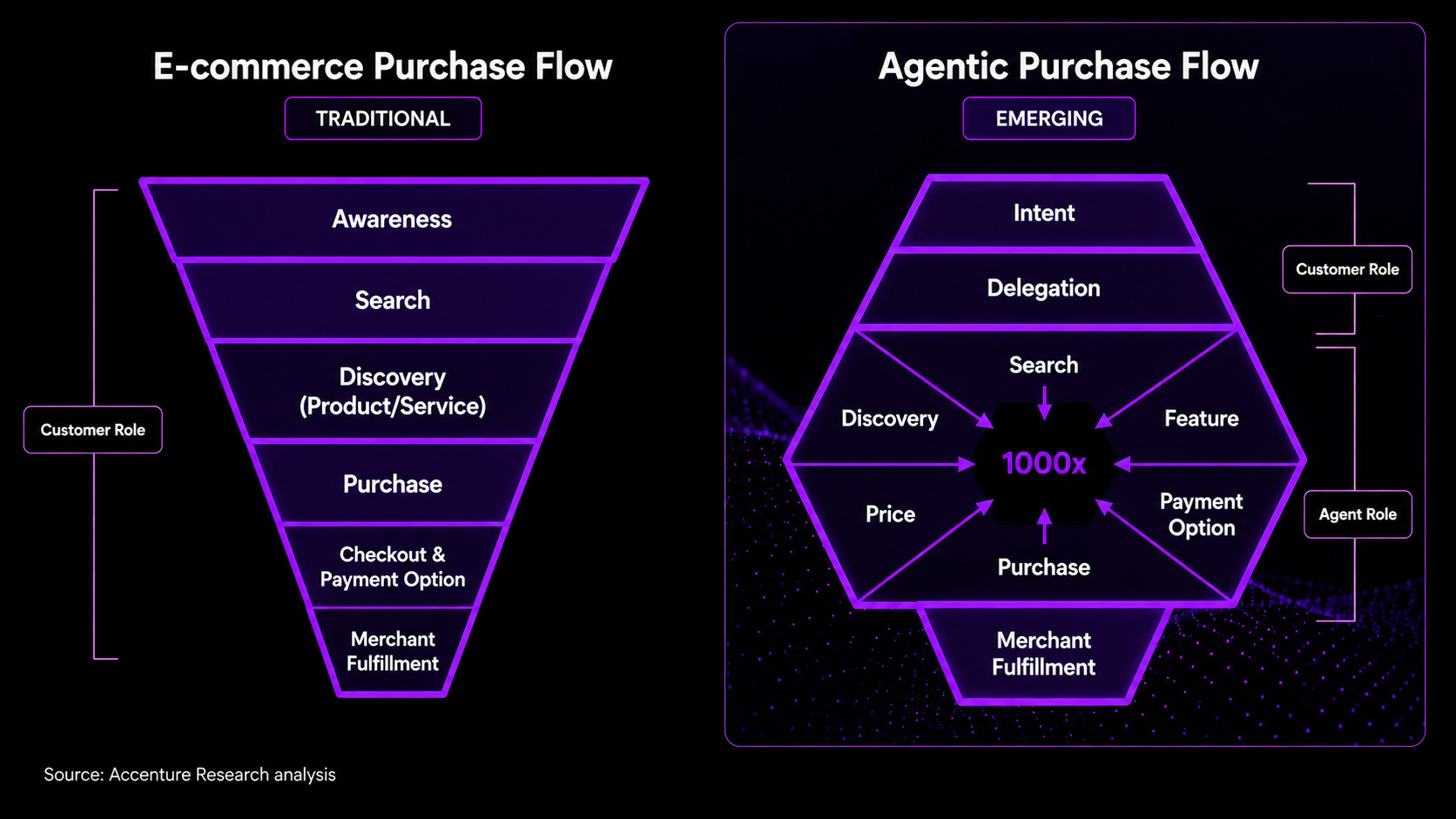
Consumers are already letting agents handle the parts of shopping that feel like effort, even if they’re not fully comfortable relinquishing control of the payment quite yet. Our research shows that among active AI users, AI has already overtaken the physical store as the number one channel for product discovery. It’s a signal that the early stages of this shift are already here.
For brands, the risk is invisibility. For banks and payment providers, it’s irrelevance. In both cases, the loss is quiet. Because it’s not necessarily about the decisions a customer makes, but the ones an agent makes on their behalf.
To understand what it means in practice, I spoke with three colleagues: Jennifer Ducarre, who leads Accenture’s consumer insights globally; Hannes Fourie, our global payments research lead; and Dominika Bosek-Rak, who leads payments research in Europe.
Their insights draw on two recent Accenture Research reports. The first, Agentic commerce rewrites payment choice, examines how the rise of AI agents is restructuring payment selection. The second, Talk to my AI agent: The new rules of brand value, looks at the shift from the consumer side and how agents are changing what brands need to deliver in order to be chosen.

Will the loyalty your brand built survive the agent layer?
Businesses have always competed for a place in the consumer’s wallet: the stored card, the saved credentials, the loyalty app. At the brand level, they compete for a place in the consumer’s mind: the instinctive reach for the same shampoo, the comfort of a familiar hotel chain, the retailer a shopper has come to know and trust.
That competition was won through marketing, habit and the friction of switching.
The agent layer changes the terms of that competition. When an AI agent handles the purchase journey—finding the product, comparing options, selecting the payment method—it doesn’t reach for what’s familiar. It reaches for what’s optimal, including the payment. “You would engage the agent and say, find me this product,” said Hannes. “The agent comes back and says, I found it and by the way, based on all the information I have from you, I can optimize payment using your points from this wallet for that store, and I can make the transaction for you.”
What makes this moment distinctive is that no single player is exempt from the disruption.
Consumers are finding that agents will automate the parts of shopping that feel like effort, but expect to stay involved in the moments that matter to them personally. Brands are discovering that visibility in a search result doesn’t guarantee selection by an agent. Payment providers are learning that being the default card in a wallet is no longer enough. And banks are realizing that the infrastructure they built for human-speed transactions may not be ready for what agents will demand.
We look at this shift from two angles simultaneously: the consumer side and the merchant and payments side. The throughline is that the loyalty businesses built, whether with customers, payment methods or vendors, will only survive if it was built on genuine value. Everything else is being quietly renegotiated as agents make decisions that humans used to make by habit.
Consumers are delegating, not disappearing
The redistribution of roles is already visible, and it looks different depending on where you sit in the transaction.
Accenture’s consumer research maps this progression through what it calls the delegation dial. Consumers aren’t handing over control all at once. They’re deciding, purchase by purchase, how much they want an agent involved and how much they want to stay in the loop.
For example, 74% are already comfortable letting an agent act on their behalf for routine tasks like handling returns or replenishing everyday items. Nearly a third would go further and let an agent decide what to buy for them, from choosing all the items in their grocery basket to deciding which telco provider to switch to.
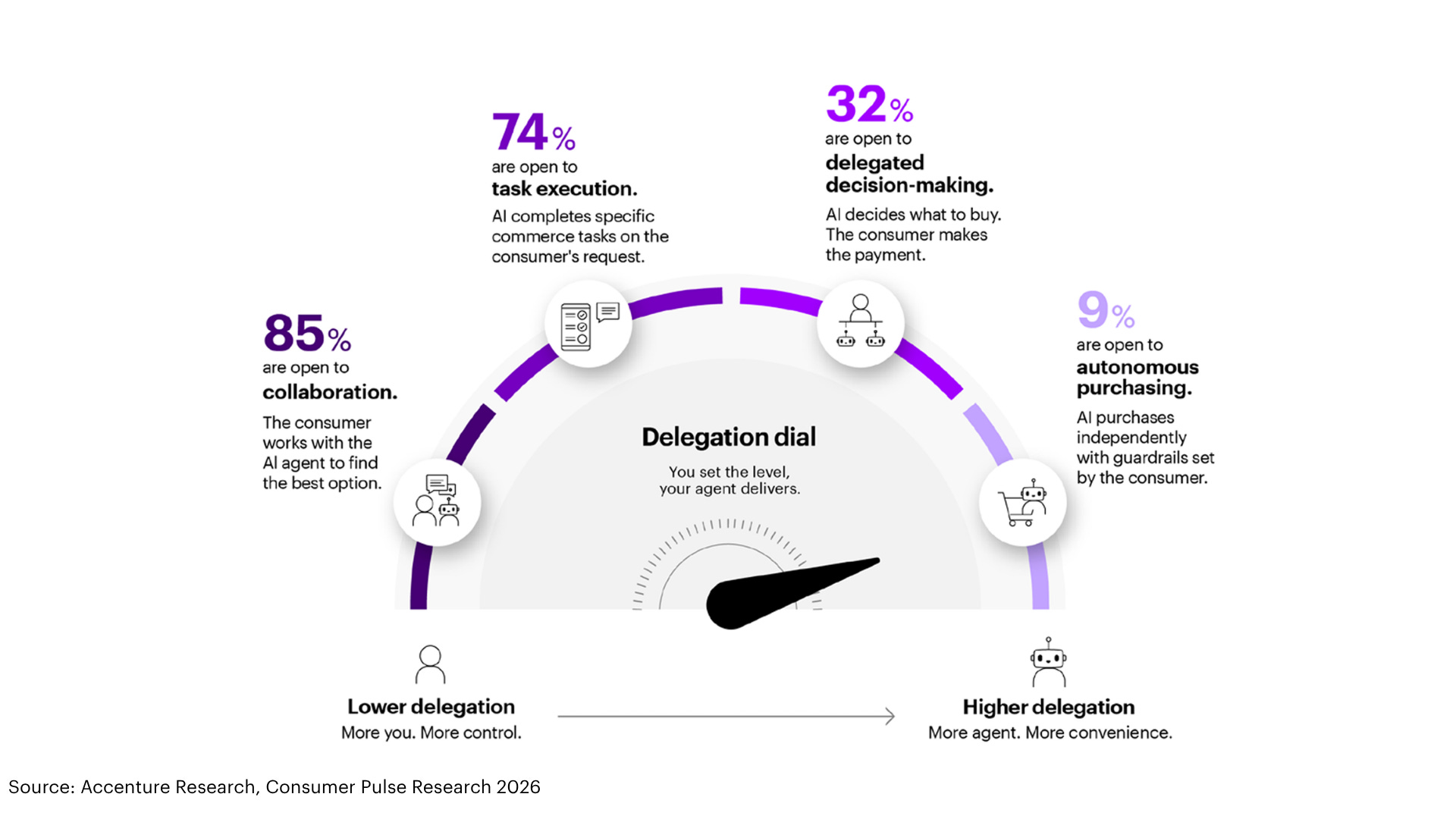
The hold-out is payments. Only 12% are currently willing to let an agent complete a purchase autonomously and only 9% are open to fully autonomous shopping.
Consumers are willing to extend that trust incrementally, starting small and moving up as confidence builds. One in three consumers told us that success with small, low-stakes purchases will drive adoption of agentic payments for more expensive, riskier items. “They just need to see it to believe it today,” said Jen.
Regardless of this discomfort at the payment level, this is still a huge shift for brands. The world in which the agent is deciding what to buy, even if the consumer makes the payments themselves, reimagines the consumer-brand relationship, explained Jen.
“It changes who is making the purchase decision, it changes what they buy, it changes where they buy it,” she said. “All of that has a huge impact on the ways in which brands generate growth, the ways in which value exists in our industries.”
When the agent picks the payment method
Hannes describes the agent as an entirely new channel, one that banks, payment providers and brands will need to learn to compete within, just as they once had to learn search, social and mobile.
For payment providers, agentic commerce levels the playing field. Traditionally, cards benefited from being the default payment method stored in a consumer’s wallet, making them the path of least resistance at checkout. In an agent-driven environment, however, an AI agent can evaluate multiple payment options, including cards, account-to-account payments, digital wallets, loyalty points and emerging payment rails, and select the one that best aligns with the user’s preferences and the merchant’s objectives. The winning payment method may be the one that offers the lowest cost, fastest settlement, strongest rewards or highest likelihood of approval.
“Payment providers can no longer rely solely on default wallet status,” said Hannes. “They must compete on the value they deliver to both consumers and merchants.”
The fraud question compounds the pressure. Agents transact at any hour, across time zones, at a volume no human can match. Accenture’s research finds that 78% of financial and payments leaders already expect fraud to increase significantly with agentic payments and 87% believe trust will be the key barrier to adoption.
Yet 60% are still relying on standard workflows to investigate agent-driven fraud, a number that reflects how quickly this shift is outpacing the systems built to manage it.
“Banks and payment companies are rethinking everything around authorization,” said Hannes. “The amount of transactions will be higher and they will happen outside of regular business hours.”
In both cases, the mechanism is the same; agents don’t carry loyalty forward unless it’s been earned through actual value. The brands and banks that built market position on friction, habit or marketing visibility are the ones with the greatest challenges at the agent layer.
Three questions worth sitting with
Here’s what stuck with me after these conversations.
Are you building trust or just building agents? Jen notes that the largest global payment companies are already creating their own agentic payment solutions and that consumer comfort will grow as those efforts succeed. But the technology being ready and the consumer being ready are two different timelines. “If trust builds, this could grow,” she said. The risk for payments leaders is investing in capability while underinvesting in the visible proof points that move consumers from 12% comfortable to something larger.
Where do you want to compete? Hannes’s research identifies three positions: own the agent, become the payment of choice by embedding into agent workflows or own the control layer that governs how money moves through rules, permissions and verified identity. The window to choose deliberately is narrow.
Are you using the trust you already have? Dominika points out that banks already hold something the agentic ecosystem needs most: established trust. In several markets, people already use bank credentials to verify identity and access public services. “Banks may be the entities that will preserve this trust and enable agent commerce,” she said. “This is a big opportunity for them.”

Worth Your Attention
The payment rails that agents will rely on are themselves being rebuilt. In a June report, Citi Institute maps how major financial infrastructure players are moving from experimentation to deployment and what it means for institutions that want to control the rails of the next financial system.
Accenture’s recent report, AI agents are rewriting the platform playbook, examines why the model most digital platforms were built on is under pressure as AI agents make purchase decisions before a consumer ever reaches a search result and what platform leaders need to do to stay relevant when the decision moment moves upstream.
Check out Accenture Research Journal, our interactive platform that lets you explore, question and navigate insights from the hundreds of reports we publish annually.
Overheard
“I have not stared into a bigger growth opportunity than what we have ahead of us in the development of the agentic web ... that then will turn into agentic commerce (and) into agentic payments. I haven’t seen anything like this since the dawn of e-commerce itself in the late 1990s or early 2000s.”
— Jack Forestell, Chief Product & Strategy Officer, Visa, speaking at Wolfe Research FinTech Forum in March
The insights above are made possible by 350 researchers, editors and AI agents across Accenture Research, as well as by the Accenture business leaders who sponsor and shape our agenda and by my colleagues in marketing and communications who help bring these insights to life.